*Transformative AGI(Artificial General Intelligence) and ASI(Artificial Super Intelligence)*
AGI and ASI are capable of fulfilling and resolving all the necessary unaided job desk tasks by humans in developing other sets of general and super technology which ultimately becomes broadly credited with being the most significant player in a transition compared to the industrial revolution.
Notice that just because AGI and ASI systems could tackle such unaided job desk tasks by humans, it does not mean they will; it’s also possible that human scientists are able to develop such necessary complement to such certain systems and potentially could make even quicker progress working in tandem mode rather than such systems can attain and accomplish regarded tasks in solo mode.
Transformative AGI and ASI-centric technologies are heavily based on novelty computing architecture which is nothing but Neuromorphic chips architecture.
*Moore's Law*
The *Moore's Law* prediction is the observation that the number of transistors in a dense integrated circuit on CPUs approximately doubles every eighteen months, although the cost of computers is almost halved. Different computer companies has proven that the term may not be very popular but the rule is still widely accepted. An example of such a law means extremely powerful computers for lesser amount of money over the time.
Moore's Law may be stated mathematically as:
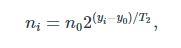where n(0) is the number of transistors in some reference year, y(0), and T(2)=2 is the number of years taken to double this number.
The values of n(i) span many orders of magnitude and it is convenient to apply Moore's Law to its logarithm, which shows a linear dependence on y:
log10n(i)=log10n(0)+[[y(i)−y(0)log10(2)]/T(2)]
*Benefits of the law:*
* Promotes healthy competition between manufacturers
* The law has given rise to hand-held devices
* Customer demands have increased over the years due to increased innovation
* Gave rise to more successful technologies due to better design tools readily available in present times
Worst case:
* Moore’s Law suffering stunting issue
* Retard to innovation
Ultimate contribution:
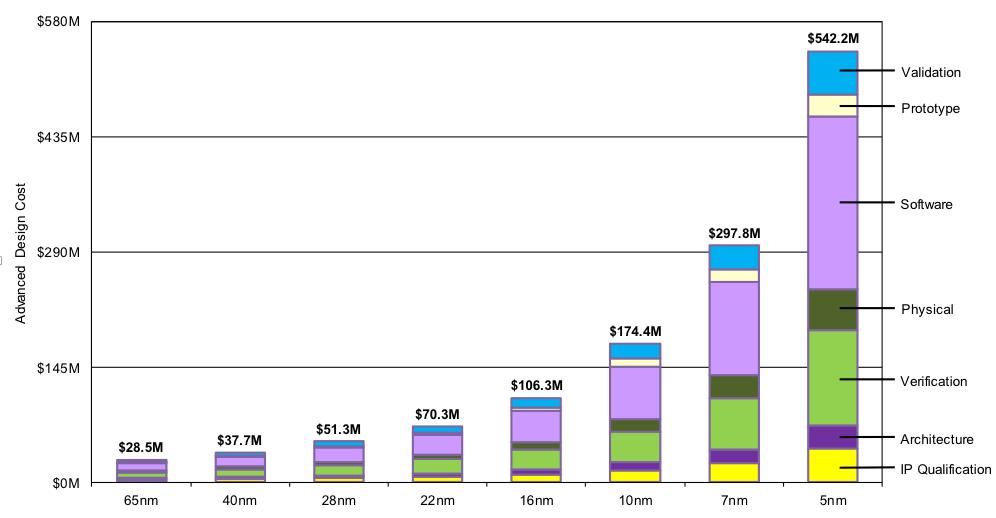
*(****IC design costs escalate, Source: IBS)***
Technologies that might end up disrupting the Moore's law completely:
* DNA Computing: DNA computing is still very early stage. But several companies, including Microsoft (MSFT), are working to push the technology forward.
* Quantum Computing: A 100-qubit quantum computer could perform over 1,000 billion billion billion simultaneous calculations. Those numbers are too big for humans to comprehend. In theory, a small quantum computer could exceed the power of a regular computer the size of the Milky Way galaxy. With enough computing firepower, a quantum computer could solve *any*problem.
**AGI and ASI Rate of Progress**
**AGI-centric and ASI-centric technologies vs Moore’s Law technologies**
**Conclusion**
A coming next generation will extend AI into areas that will correspond to human cognition. This is critical to overcoming the so-called “brittleness” of AI solutions based on neural network training and inference, which depend on literal, deterministic views of events that lack context and commonsense understanding. Next-generation AI will or should be able to address the novel situations and ability to automate ordinary human activities.
This is where Neuropmorphic computing will come into play. The key challenges in it are matching a human's flexibility, and ability to learn from unstructured stimuli with the energy efficiency of the human brain. The computational building blocks within neuromorphic computing systems are logically analogous to neurons. Spiking neural networks (SNNs) are a novel model for arranging those elements to emulate natural neural networks that exist in biological brains.