Recorded Q&As From Nov 3 FRO Talks
8
Thank you to everyone who came out for November 3rd's FRO talks event! Thank you especially to attendees who submitted questions via the Q&A interface. Research teams answered some of these questions by text. We've included those Q&As here for the benefit of FRO-Casting Tournament participants. ------ *Alice Wu: What is the core difficulty that currently prevents researchers from collaborating at a large scale? How does the FRO structure solve this difficulty?* ##### Alice Wu: **In traditional academic institutions, the processes for funding, evaluating and rewarding scientific achievement are conducted primarily on an individual basis. Individual PIs must compete to secure multiple research grants to fund their research lab and personal salaries; they then compete to obtain promotion and tenure within institutions. On the other hand, FROs are funded as a whole organization for 5-7 years at a time, and the success of the FRO is dependent upon successful, tightknit collaboration within the organization.** <br /><br /> *It's not too risky but do you have a sense that you have the bacterial genetics outside of the simple pET vectors?* ##### Ethan Bier: **Good question. We have tried several different plasmids with alternative origins of replication that have differing host ranges. One of them (a medium copy number origin - pBBR1) sustains conjugation to a fairly broad range of bacterial recipients. There also are a large variety of other conjugal systems that encompass broad ranges of other types of bacteria. Testing these other systems would be important.** <br /><br /> *@ethan Bier: did you try any prototypes or test it at a small scale? How can reduce the risk of the failure of this project?* ##### Ethan Bier: **Yes, we have tested it flasks of growing bacteria where we do see ~100,000 fold reduction in resistance to the targeted (but not non-targeted) antibiotic resistance gene. We are now analyzing the various ways the system can fail so that we can engineer yet more robust systems.** <br /><br /> *How do you ascertain if the perturbations you induce in the activation of circuit or connectome will keep the worm’s behaviour in context or completely decontextualize it such that inferring anything would end up being meaningless ?* ##### Konrad Kording: **To be clear about my answer. We want to know the IO function of every neuron. It is possible that neurons are very nonlinear and you can never extrapolate. Then our project will fail unless we can cover all relevant contexts.** **Indeed, it appears challenging unless the perturbations are calibrated somehow and we can retain control of some sorts. Thanks Konrad!** **But also, obviously we will calibrate it.** <br /><br /> *You'll get "recombinant mAbs" from companies. Q: Will they share a sequence with you? Or is it that case that you will just help us to know what antibody to buy from one properietary manufacturer?* ##### YCharOS Team: **If the antibody comes from academics or non-profits that release the sequences, they are released (and we have done that). When we work with companies, we make sure that they agree distribute their antibodies without IP restrictions (so anyone can buy them and use them without restriction). We would of course prefer that all sequences are made public, but in the real world nearly all of the high-quality antibodies are invented and produced in the private sector. And of course folks are happy to buy products if they work! (from fridges to cars to antibodies!)** <br /><br /> *@ycharos: why do industry collaborate with you? what's the benefit for industry to join your ecosystem?* ##### YCharOS Team: **"There are many benefits to the industry collaborators that translate through to the community:** **1) they get an independent third party validation of their reagents** **2) they want to clean up their cataloges and they have trust in our data and the open science ecosystem (they are actively removing products and modifying recommendations to customers)** **3) our data reveals gaps in the market"** <br /><br /> *I have one non-technical question - what about prospective FROs working on social sciences, e.g. testing new institutional structures for managing extreme risks, drawing on transdisiplinary breadth, but is less explicitly quantifiable time scale on which this work would iterate, yet meeting the other FRO criteria?* ##### YCharOS Team: **That’s an interesting question! The community of folks interested in FROs have primarily focused on its applications in science research, so I don’t know what the appetite would be for FROs for social sciences** ----- 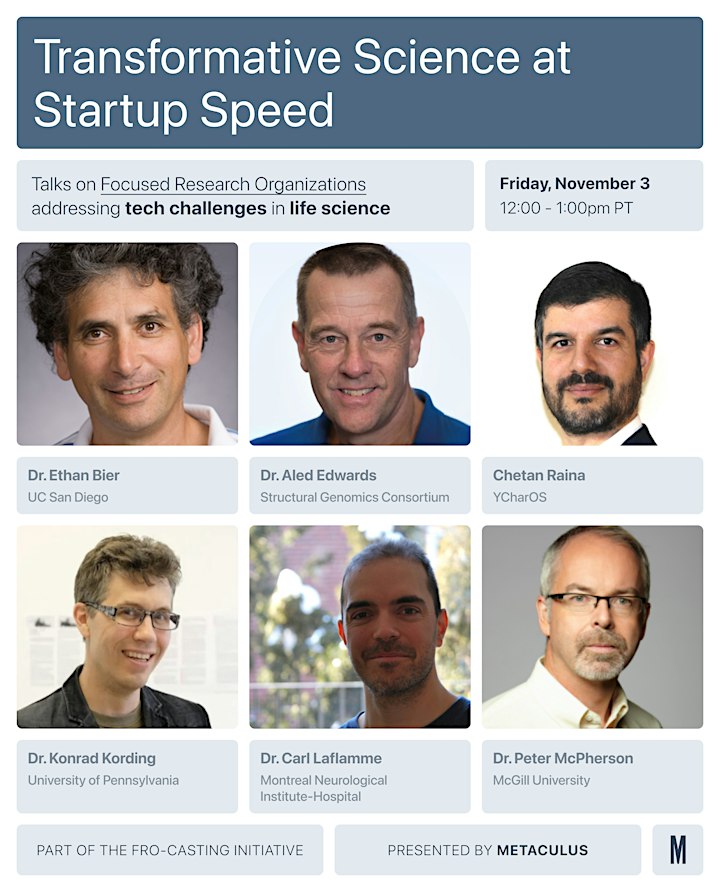 Join Metaculus Friday, November 3rd, 12:00-1:00pm PT for a series of short technical talks addressing life science challenges with ambitious Focused Research Organizations (FROs). Part of the <a href="https://www.metaculus.com/tournament/fro-casting/">'FRO-Casting' Tournament</a>. #### <a href="https://www.eventbrite.com/e/metaculus-presents-transformative-science-at-startup-speed-tickets-745683618777?aff=oddtdtcreator">Register for free tickets to this online event here</a> This is an opportunity to pose your questions to the research teams behind the following FRO proposals: #### Teams will present on the following proposals: ### <a href="https://www.metaculus.com/project/2638/">Characterizing Antibodies Through Open Science</a> > "Many antibodies that scientists purchase from commercial manufacturers to conduct their research do not work as advertised, because most have never been validated properly. This project brings together the public and private sectors to conduct independent, third-party testing of commercial antibody manufacturers’ catalogs and publish the results in the public domain, such that no scientist ever uses an ineffective antibody again." - Chetan Raina, YCharOS - Dr. Aled Edwards, Structural Genomics Consortium - Dr. Peter McPherson, McGill University - Dr. Carl Laflamme, Montreal Neurological Institute-Hospital ### <a href="https://www.metaculus.com/project/2475/">Reducing Antibiotic Resistance In Aquaculture</a> > "Research and engineering to reverse antibiotic resistance in aquatic bacteria, through the application of a well-validated CRISPR-based genetic system, can help catalyze safer, more sustainable land-based aquaculture as a nutritious and affordable food source." - Dr. Ethan Bier, UCSD ### <a href="https://www.metaculus.com/project/2645/">Measuring Complete Neuronal Input-Output Functions</a> > "Measuring how neurons integrate their inputs and respond to them is key to understanding the impressive and complex behavior of humans and animals. However, a complete measurement of neuronal Input-Output Functions (IOFs) has not been achieved in any animal. Undertaking the complete measurement of IOFs in the model system C. elegans could refine critical methods and discover principles that will generalize across neuroscience." - Dr. Konrad Kording, University of Pennsylvania The FRO-Casting Tournament is a joint pilot project by Metaculus and the Federation of American Scientists that harnesses forecasting to identify promising research directions and deliver feedback. Learn more about it <a href="https://www.metaculus.com/tournament/fro-casting/">here</a>. <a href="https://www.eventbrite.com/e/metaculus-presents-transformative-science-at-startup-speed-tickets-745683618777?aff=oddtdtcreator">Get your free tickets</a>