AI Philanthropy Workshop Report
1
*Identifying high-value goals for AI funders and how best to achieve them* On March 1st, 2024, Metaculus, the [Effective Institutions Project](https://effectiveinstitutionsproject.org/) (EIP), and the [AI Objectives Institute](https://ai.objectives.institute/) (AOI) brought together funders, technical AI experts, and professional forecasters for the first in a series of workshops focusing on AI philanthropy. We aimed to create a space where attendees could take advantage of collective reasoning tools, do their best thinking together, and identify promising avenues for future AI grantmaking and research. This report summarizes some of the strategic goals attendees focused on, the deliberative tools they used, and some of their takeaways from the workshop. # Tooling A pre-workshop survey collected participants' open-ended visions for the ideal state of AI in 2030 and how humans interact with it. AOI's [Talk to the City](https://ai.objectives.institute/blog/introducing-talk-to-the-city-our-collective-deliberation-tool) (TttC) LLM tool generated summaries of the results and identified key goals and disagreements. Attendees then piloted MetaLearner, an iterative tool for consensus building, to focus the discussion on the top five goals to be discussed and debated over the workshop. 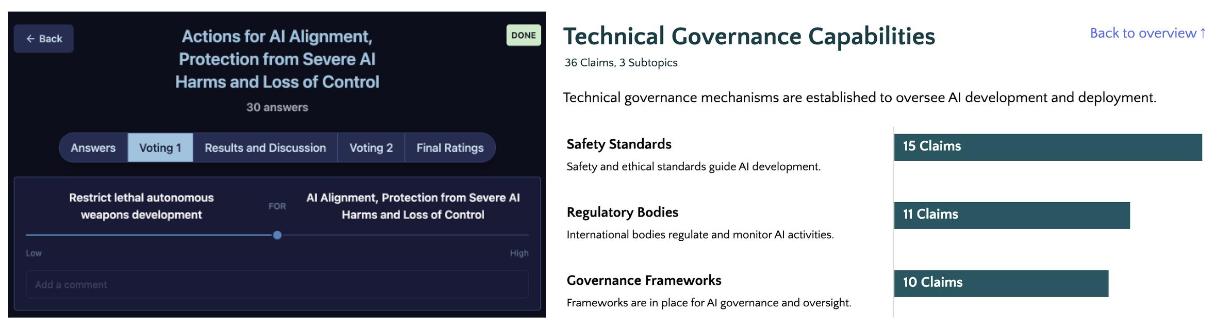# Goals for the Future Attendees brought a variety of perspectives and priorities to the event. The below represent syntheses of a subset of the goals for AI in 2030 where there was greatest agreement among attendees. ## AI Supports Diversity of Goals, Self-Actualization for All If the goal is met, in 2030, AI is designed with all people and with the planet in mind, with a rich diversity of values present and respected. The richness and diversity of values is honored just as in our ideal biosphere. If this goal is met, in 2030, AI is used in service of humans and humanity, especially those most marginalized, left out or harmed by the old status quos and systems of power. AI helps humans to better understand what would make us most fulfilled, helps us have more accurate beliefs about the world, helps us to create beautiful art, and helps us overcome language and other communication barriers. It also expands our moral imagination so that we treat animals and all moral agents better, including AIs if relevant. ## Widespread AI and Economic Benefits If this goal is met, in 2030, there is widely deployed superhuman AI running at low cost with minimal unintended harms. In a harmonious way, humans turn to AI for all sorts of problems and are provided assistance. AI is running more of the day-to-day tasks in life, including being a critical system for the provision of clean water, energy, and housing. Specialized AI models are being used to speed up medical research, and regulations have been improved so that they are not a bottleneck for new treatments and technologies that are very beneficial in expectation. This state of affairs allows humans the time and space to turn to more creative outlets. And, because there are fewer jobs for humans, if this goal is met, there is inclusive and global unemployment compensation. ## AI Alignment, Protection from Severe AI Harms and Loss of Control **1.** If this goal is met, in 2030 AI is broadly aligned with human goals, and our vulnerable world is proactively mitigating against AI's democratization of mass destruction. Progress has been made toward alignment, mechanistic interpretability, and other technical AI safety and governance capabilities. It’s now possible to secure model weights and hardware, and monitor training runs. Building on these advances, humanity is developing an international network – similar in its international and collaborative spirit to the International Space Station – of several global-scale AI-powered cyber-physical systems which primarily serve to protect humanity from rogue AI and other catastrophic risks. A related multilateral organization oversees an effective hard compute governance regime, limiting the amount of computational resources that can be deployed for training runs by private actors. **2.** With these governance mechanisms in place, only human-level AI is accessible to the general public, and superhuman AI is only used in boxed settings with quantitative safety guarantees. AI labs invest heavily and intelligently in safety and security; at the very least, there are many layers of different kinds of security around each deployed model and models under development. Worldwide cybersecurity in general is much better. There are many laws, social norms, and enforcement mechanisms in place against open-sourcing any AI model which would make it easy in expectation for bad actors to develop/access very damaging tools (pathogens, extremely persuasive bots, etc.). AI-automated deployment of AI is illegal. ## AI Augments Human Reasoning and Sciences If this goal is met, in 2030 AI is significantly enhancing human cognition and communication, helping us have more accurate beliefs about the world. AI has become a powerful tool to aggregate and synthesize information reliably, including structural information with low information redundancy (eg hard sciences + engineering) leading to new breakthroughs and reduced costs of exploration. ## Protection from Economic and Political Catastrophes If this goal is met, in 2030, the world has avoided the erosion of democratic norms and the collapse of economic security. There is little unemployment due to AI, or there is global unemployment compensation or income support to compensate for job loss caused by AI. The capability gap between the rich and poor is minimized, ensuring that the poor have access to valuable AI tools. --- Participants formed into groups to each focus on one of these high-level goals and to discuss some of the philanthropic interventions that might best advance them. Further: * Which actions could support more than one goal? * Which actions might advance some goals at the expense of others? * Were there ways to refine and prioritize the portfolio of interventions under discussion to optimize for the collective good? The workshop concluded with a discussion identifying critical points of agreement, collaboration opportunities, and cruxes to resolve through further research or the unfolding of events. ## Some Reflections From Participants *My small group had representatives from four of the largest funders in the space and converged on a number of interesting consensus projects, including "fund research on bargaining solutions for multi-stakeholder negotiation of AI safety guardrail specifications"—which informed a recent grant on CDCT (collective decision making, coordination, and trust).* *In addition, I found it valuable that one of my top priorities wasn't widely shared, and that one intervention I dismissed as too expensive was widely lauded. All in all, it was a decision-relevant workshop for my grantmaking, partially because we just rarely have so many large funders in the room together.* — *JueYan Zhang, AI Safety Tactical Opportunities Fund* *I think this meeting structure was* ***extremely*** *valuable and I wish 10 more meetings like this would happen this year across many different intersections of civil society and AI risk discourse.* — *Andrew Critch, Survival and Flourishing Fund* --- We want to thank the attendees of this inaugural AI Philanthropy workshop, AOI and EIP for their collaboration in organizing the event, and The Commons SF for hosting us! **Are you a funder or technical AI expert who would be interested in attending a future workshop? Reach out to*****info [at] effectiveinstitutionsproject.org*****.**